Guidelines for written assignments

Please note that these guidelines apply for the degree programmes of the Schools of Wellbeing and Rehabilitation and Examination.
You can find guidance on the degree programmes in other fields through the degree programme-specific channels. Instructions for technology students are available in the respective degree programmes' OMA work spaces.
There are two layout models for learning assignments:
- the layout model for an extensive written assignment used in these guidelines, and
- the standard layout model.
The extensive written assignment model is used for theses and extensive learning assignments. The standard layout is suitable for short learning assignments, reports, and documents such as applications, meeting documents, and client letters.
You can read the instructions on this website or download the Guidelines for written assignments Word file, which contains more illustrated examples and a document standard layout template. The file also serves as a template.
Writing written assignments
An extensive written assignment consists of the following parts:
- Title page, or cover page
- Abstract in Finnish (only in thesis)
- Abstract in English (only in thesis)
- Table of contents
- Introduction
- Chapters and subchapters dealing with the subject
- Discussion
- Sources
- Appendices
The number of heading levels should be proportionate to the scope of the work. In a short text, there are only main chapters. In a long text, there may also be subchapters that structure the text. There must not be single, isolated subchapters. If the text contains, for example, subchapter 2.1, it must also contain at least subchapter 2.2.
The layout of Metropolia’s text template is created using Styles saved in the template. The template is intended to be used with Microsoft Word.
Paragraphs and headings start from the left margin of the page. Paragraphs are formatted using Body Text 1 Style, with font Arial 11 pt, line spacing 1.5, and left alignment. Headings are formatted using Heading Styles. In learning assignments and theses, forced page breaks are not used between chapters; instead, the text continues directly after the preceding paragraph.
The first page number appears on the introduction page in the upper right corner. The cover page, abstract, and table of contents are not included in the page numbering. Appendices are numbered consecutively in the header (e.g., Appendix 1, Appendix 2) and titled on the heading line (e.g., Research Permission Request).
If the text contains images, they are numbered consecutively and provided with an explanatory caption in font size 10 pt (Image caption) placed below the image (see Figure 1). The source of the image must always be indicated with a source reference. Images that are subject to copyright legislation may only be used with the permission of the author or the photographer.
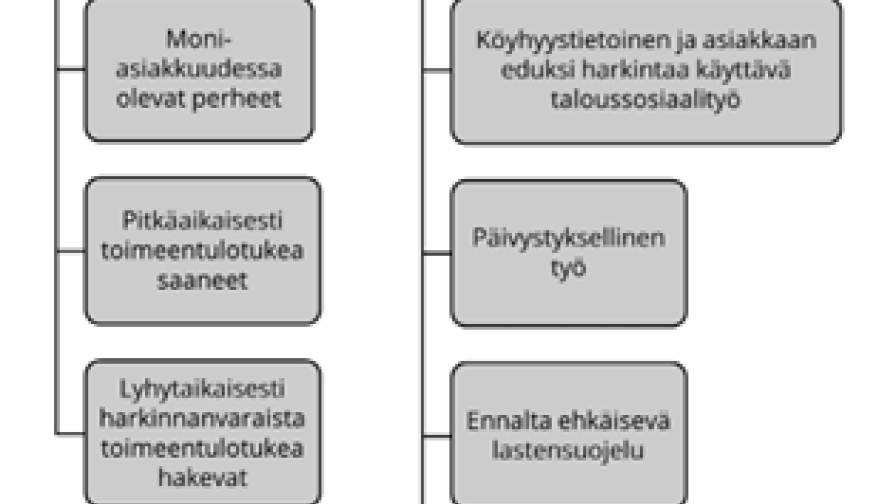
Figure 1. Families with children as recipients of discretionary social assistance and as clients of adult social work. (Liikanen 2025: 227).
Tables are also numbered consecutively. The explanatory text, i.e. the table caption, is placed above the table in font size 10 pt (Table caption), see Table 1. The source of the table must be indicated with an in-text reference. If no source is indicated, the reader assumes that the table has been created by the author of the learning assignment or thesis.
Table 1. The geographical locations of rehabilitation functions (Saarinen, Henriksson and Ala-Kauhaluoma 2012: 23).
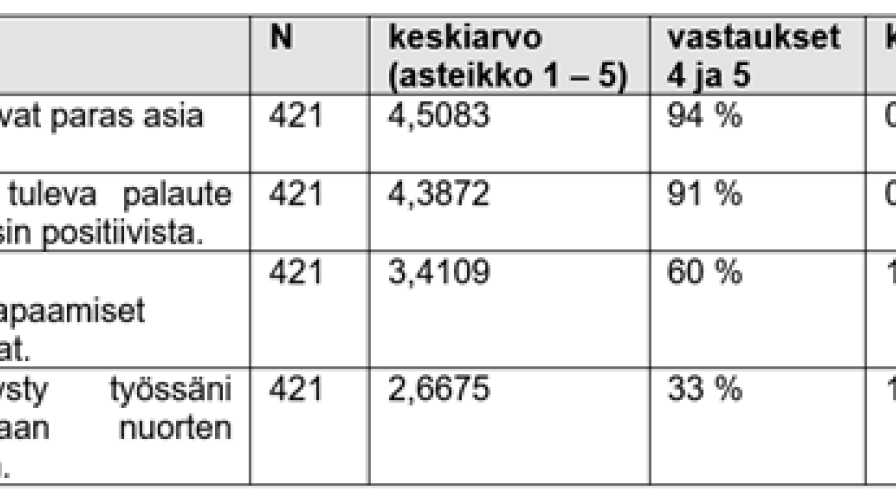
Even when an image or table has been modified or only partially used, the details of the original table must be clearly indicated. In such cases, the source reference is supplemented with the note ‘adapted from’.
- Example
(Adapted from Saarinen, Henriksson and Ala-Kauhaluoma 2012: 23.)
It is not advisable to start or end a chapter with an illustration or a table. Any illustrations or tables should also be referred to in the text.
Sources are generally used in learning assignments primarily by paraphrasing. Direct quotations, i.e. citations, should be used sparingly. A quotation may be appropriate in situations where source material is being quoted (e.g. excerpts from interviews) or when it is necessary to convey the exact wording of the original text. A quotation is indicated in the text by typographical means, using the Quote Style. In this style, the text is indented and the line spacing is 1. Quotation marks are not required but the source must be referenced.
- Example:
It’s been difficult to find motivation for reading. Reading is not really my thing. I like audio books, though. (P3)
The courses have different guidelines on how artificial intelligence (AI) can be used. The guidelines are based on Metropolia’s instructions, which are based on the recommendations on the use of artificial intelligence for universities of applied sciences of Arene ry, the Rectors’ Conference of Finnish Universities of Applied Sciences.
Artificial intelligence can never be the author of a learning assignment or a thesis. AI may be used to support the planning and refinement of the work, but the student is personally responsible for the content of the text and for ensuring that the work follows good scientific practice.
If the thesis is conducted as part of a project, the student must also comply with Metropolia’s guidelines on the use of artificial intelligence in RDI activities. AI must not be used in data analysis, and copyrighted or confidential material must not be entered into AI tools.
The use of artificial intelligence and how its use should be indicated must be discussed with the course instructor and the thesis supervisor. More detailed instructions on how to acknowledge the use of AI in different situations are provided in
Guidelines are updated regularly.
Referencing sources
In all written assignments, the principles of scientific writing are followed. Sources are cited in the text, and a list of references is included at the end of the text. If a source is cited in the text, the bibliographic details of that source must always be provided in the list of references. Each source listed in the reference list must have at least one corresponding in-text citation. Careful referencing ensures reliability, traceability, and comparability of information.
A source must always be cited when another text has been used in the written assignment, such as research results, tables, figures, or expert knowledge. A citation consists of three parts:
- author’s surname (if there is no author, title of the source work, or the publisher’s name for corporate authors)
- year of publication (omit if not known)
- page number(s) (omit if not known).
The same logic applies to both printed and electronic sources. Below are examples of different types of in-text citations. The first citation has two individual authors, the second citation has no personal author, and in the third citation the authors are indicated as a working group, in which case the citation begins with the title of the source:
- Examples:
- (Nivala & Ryynänen 2024: 85)
- (Regional Welfare Management)
- (ADHD. Current Care Guidelines 2025)
The page number in a citation indicates precisely where in the source the information has been taken from. With electronic books (hereafter e-books) read using different e-reading applications, a challenge is that page numbers vary depending on the font size or the reading program used by the reader. If an e-book does not have fixed page numbers, page numbers are not included in the citation. In sources published in PDF format, page numbers remain the same and should be included.
If the author and the year of publication of an online text are known, the in-text citation includes the author’s surname and the year of publication. Many online texts do not display separate page numbers, so they cannot be included in in-text citations either, even if the referenced content comes from a specific part of the online text:
The reference list reveals a great deal about how the writer positions themselves within the traditions and communities of their field of research, how thoroughly they are familiar with the theoretical foundations of the field, and how broadly they have sought information on their topic (Korpela 2016).
A web address is never included in an in-text citation, but only in the list of references. If the author of an online text is unknown, the name of the organization maintaining the document or website is used in the citation. The choice should be made consistently, taking into account the retrievability of the source and the evaluation of its content. In the following example, the title of the document is used in the citation:
- Example
The wellbeing services county council decides on the region’s strategic priorities and obliges the various functional areas to take them into account in their own plans (Regional Welfare Management).
Statutory instruments (such as acts and decrees) are cited by their name, the year in which the instrument was issued (though not necessarily the year it entered into force), and the statute number:
- Example
(Data Protection Act 1050/2018)
When a reference is made to a specific section, the section number is also included in the in-text citation:
- Example
(Data Protection Act 1050/2018 § 35)
In academic texts, the author's thinking is evident in how they refer to their sources and how they put them in discussion with each other. Professional observations and personal thoughts may also be presented in academic texts, but they must be justified. In a good written assignment, personal views and previous research and expert knowledge are naturally intertwined.
Whenever a source is written by one or more authors, the authors' surnames are given in the reference. With several authors, you can simplify the reference as follows: with three to five authors, provide all the authors in the first reference. You can later reference the same source using only the first author's name and ‘et al.’ (among others), along with the year of publication. If there are six or more authors, use 'et al.' starting with the first reference.
- Examples
- (Emmerling, Canboy, Serlavos and Batista-Foguet 2025: 661)
- (Attree et al. 2011: 787.)
Works published by the same author in the same year should be listed separately in the list of sources, and with lowercase letters a, b, c, etc. in the in-text references.
- Example
(Roivas 2025a; Roivas 2025b; Roivas 2025c)
The full stop indicates whether you are referencing one or more sentences from the same source. The full stop should be placed after the closing bracket when referencing a single sentence.
- Example
The socio-pedagogical perspective is not limited to how things are but also directs attention to how things could be and what could be done to change them (Nivala & Ryynänen 2024: 348).
The full stops should be placed after the last referenced sentence and inside the closing bracket when referencing more than one sentence.
- Example
Throughout its history, social pedagogy has made extensive use of concepts from philosophy, sociology, and educational sciences. The connection to these related fields remains essential, as the core idea of social pedagogy is to seek to understand the reality in which people live, grow, and encounter various challenges. (Nivala & Ryynänen 2024: 353.)
When referring to multiple sources – that is, when the same information appears in more than one source – the different sources are separated by a semicolon.
- Example
The demand for effective healthcare services has initiated the need for socially sustainable practices in healthcare as well as outside of the sector (Eizenberg & Jabareen 2017: 11; Silvis 2012).
Referencing sources can be either content-focused or author-focused. An author-focused referencing style is used when it is relevant to highlight the author of the source or when one’s own observations or viewpoints are presented earlier in the same paragraph before referencing. Here both referencing styles are used side by side:
- Example
Switching the working language from Finnish to English is not necessarily unproblematic: some people may find speaking English burdensome, and not everyone who comes to Finland speaks English (Kotilainen et al. 2022). According to our observations, highly educated individuals may experience shame if they do not speak excellent English. Korpela and Lehtimaja (2023) therefore encourage work communities to discuss language skills and language-learning needs openly. Language is more than just a means of interaction, and strong emotions may be associated with language learning (Korpela & Lehtimaja 2023: 187–188).
In the texts, primary sources (i.e. first-hand sources) must be used rather than secondary sources (i.e. sources that make use of primary sources by referring to them). If a primary source is not available but reference is made to the information it contains, it must be made clear to the reader that the source is second-hand. Here’s an example of a clear secondary reference:
- Example
According to a report by the Ministry of Social Affairs and Health (2018), early intervention in social services has been shown to reduce the need for more intensive support later (Virtanen 2022: 46).
There are different practices regarding how sources are listed in the reference list when using secondary citations. Sometimes both the primary and the secondary sources are required to be listed, but in learning assignments and theses at universities of applied sciences, the recommended practice is to include in the reference list only those sources that have been read firsthand.
Principles of compiling a list of references
Sources referred to in the text are listed in the reference list in alphabetical order. A reference list entry begins in the same way as the in-text citation: for example, if the citation is in the form (Statistics Finland 2024), the source can be found in the reference list under the letter S. The reference list must always include the following basic information:
- who (author)
- when (year of publication)
- what (title of the work and any subtitles)
- where (publisher’s place of publication and the publisher).
It is important to understand the difference between the publisher and the printer. The publisher is responsible for the content of the work, whereas the printer carries out the printing according to the publisher’s instructions. The reference list always includes the publisher’s information. Editions other than the first, the translator, and any series title are also indicated.
Electronic sources are listed in the reference list in the same way as other sources, beginning with the author or, if the author is not known, with the name or title of the document. Next, the publication date or last update date of the page is given, followed by the website maintainer, the type of document if applicable, the web address, and finally the date on which the source was accessed (e.g. Accessed 5 Jan 2026).
If a source has a permanent URN or DOI identifier, it should always be used as the web address. A DOI (Digital Object Identifier) is an international standard for scholarly articles, while a URN (Uniform Resource Name) is a Finnish persistent identifier for official documents. A regular URL indicates the location of a source on a specific webpage, but if the page is moved or the server changes, the link may break. URNs and DOIs always direct the reader to the correct source. The access date may be omitted for sources that have a URN or DOI.
Scholarly and professional works and articles
Citations and the reference list indicate how the writer positions themselves within the traditions and communities of their field, how familiar they are with the theoretical background of the discipline, and how broadly they have sought information on their topic. Sources based on analysis, such as peer-reviewed original research articles, are the most central sources also in learning assignments and theses. In addition to scholarly sources, it is often possible to also use professional sources.
Scholarly and professional sources may be printed or electronic, and they may have one or more authors. It is important to understand that an article or chapter published as part of an edited book or journal is always an independent source and must be cited using the name or names of its author(s). In the reference list, after the author’s name and the year of publication, it is then stated which journal or book the article originates from. The names of the editors are given, as well as the first and last page numbers of the article.
When citing a work in a different language from the one you are using in your text, write the reference in the original language but provide a translation of the title in square brackets after the original title. If a translation of the title is provided by the author of the work you want to cite, use this translation. If no translation is provided, translate the title to the best of your ability. If the work cited is part of a larger work (e.g. a chapter in an edited book), you do not need to translate the title of the larger work (e.g. the title of the edited book). If the original language uses a different alphabet from the language used in your text (e.g. Arabic or Russian), transliterate the text into the Roman alphabet.
Below are examples of different types of scholarly and professional sources. After that, more detailed instructions are provided for different source types.
- The entire work is one source:
- Eloranta, S., Hoffrén-Mikkola, M., Komulainen, M., Mikkola, T., Teeri, S. & Roivas, M. 2023. Onnistunut etäkotihoito [Successful remote home care]. TAITO series 125. Helsinki: Metropolia University of Applied Sciences. https://urn.fi/URN:ISBN:978-952-328-409-8
- Foucault, M. 2023. The Order of Things: An Archaeology of the Human Sciences. New York: Pantheon Books.
- Hirsjärvi, S., Remes, P. & Sajavaara, P. 2024. Tutki ja kirjoita [Research and write]. 23. edition. Helsinki: Tammi.
- Statistics Finland. 2024. Terveyteen liittyvien verkkopalveluiden käyttö kasvaa nopeasti [The use of health-related online services is growing rapidly]. Review. https://stat.fi/julkaisu/cm46zt2kj04sa07vy06eodiku. Accessed 19 January 2026.
- The source is an article or a chapter that is part of an edited work:
- Rantanen, T. & Kokko, K. 2022. Vanhenemisen tutkiminen [Studying ageing]. In Rantanen, T., Kokko, K., Sipilä, S., & Viljanen, A. (eds.), Gerontologia. 12–22. Helsinki: Duodecim.
- The source is an article published in a scholarly or professional journal:
- Latomäki, M., Runsala, E., Koivisto, A., Kylmä, Jari & Paavilainen, E. 2020. Omaishoitajien kokema kuormittuneisuus ja kaltoinkohtelu [Burden and maltreatment experienced by family caregivers]. Sosiaalilääketieteellinen aikakauslehti 27 (2), 100–123. https://journal.fi/sla/article/view/75847. Accessed 5 June 2020.
- Leino, T., Turunen, J., Pehkonen, I. & Juvonen-Posti, P. 2022. Important Collaborative Conditions for Successful Economic Outcomes of Work Disability Management: A Mixed Methods Multiple Case Study. Journal of Prevention, Assessment & Rehabilitation 74 (2), 685–697. https://doi.org/10.3233/WOR-210026
An edited work can be identified by the fact that the editors are listed separately. Each chapter or article, in turn, has its own author(s), whose names are given in connection with the chapter or article.
Articles are also published in scientific or professional journals. Scientific journals are journals that use a referee system, i.e., a peer-review process. Often, the journal’s information clearly states – for example through a peer-review label – whether the journal uses external experts as peer reviewers
An article from a professional or scientific journal is listed in the reference list starting with the author and the title of the article. In addition, the name of the journal is given, as well as the journal’s volume (i.e., year), the issue number in parentheses, and the first and last pages of the article.
Other sources
In learning assignments and theses, sources other than the scientific and professional works and articles described above are sometimes also used, such as acts and decrees, websites, blog posts, podcasts, theses, and newspaper articles. In such cases, the type of source and other key background information are provided in the reference list. Below are examples of how to cite such sources:
- Examples
- Hyvinvoiva ikäihminen. Mikä ikä? [A well-being older adult. What age?] Podcast, 25 Nov 2022. https://open.spotify.com/episode/6v9xkbFou0WVSgyxs0Dh54. Accessed 27 November 2025.
- Korpela, E. 2016. Totuus lähdeluettelosta [The truth about the reference list]. Kielikuraattori blog, 7 December 2015. https://kielikuraattori.wordpress.com/2016/12/07/totuus-lahdeluettelosta/. Accessed 5 January 2026.
- Lastensuojelun käsikirja [Child Protection Handbook]. Helsinki: Finnish Institute for Health and Welfare. https://thl.fi/julkaisut/kasikirjat/lastensuojelun-kasikirja. Accessed 27 November 2025.
- Siira, T. 2025. Digitaalisten asiakasohjeiden saavutettavuus vahvistamassa perhelähtöistä ohjausta lasten ja nuorten kuntoutuksessa [Accessibility of digital client instructions strengthening family-centred guidance in the rehabilitation of children and young people]. Master’s thesis. Helsinki: Metropolia UAS. https://urn.fi/URN:NBN:fi:amk-202504065778
- Guiding Principles for Ethical Occupational Therapy. World Federation of Occupational Therapists. 2004. https://wfot.org/resources/wfot-guiding-principles-for-ethical-occupational-therapy. Accessed 27 October 2025.
The source information for documents available online sometimes has to be searched for on different subpages. If the author is not known, the reference entry is started with the name or title of the document. Next, the page’s publication date, the organization maintaining the website, the possible type of document, the web address, and finally the date of access are indicated. The following shows how the source information would be recorded for a document from the Finnish Institute for Health and Welfare’s website when the author or publication date is not visible, but update information is available:
- Example
Promoting equality. Management of health and wellbeing promotion. Helsinki: Finnish Institute for Health and Welfare. Updated 5.12.2023. https://thl.fi/en/topics/management-of-health-and-wellbeing-promotion/promoting-equality. Accessed 5 January 2026.
In learning assignments and in the thesis, published sources are generally used. If it is necessary to use unpublished sources, such as an organization’s internal documents, permission must be obtained to use them. A teacher’s course slides or another student’s learning assignments may not be used as sources.
Creating accessible documents
These accessibility guidelines apply especially to theses and other texts published in connection with studies. They are based on the EU Accessibility Directive (2016/2102). The author of a thesis must ensure the accessibility of their document
- by using styles
- by setting images in line with the text
- by creating alternative text (alt-text) for images
- by finalizing the document properties.
When the content and layout of your document (e.g. a thesis) are otherwise in order, finalize the document by defining its properties. This is important to ensure the accessibility of the PDF file when you convert the Word document into PDF format.
Add the document title to the file properties. For example, for a thesis, enter its main title. Select File – Info – Properties – Title.
A special feature in Word allows you to check whether your document is accessible.
- Choose File, then Info.
- Choose Check for Issues.
- Choose Check for Accessibility.
After this, a window called Accessibility Assistant opens on the right side of Word. The results of the check show any possible errors and warnings. You can get more information about the results by clicking the name of an item on the results list. Word also explains the reason for the issue and provides instructions on how to fix it. Fix at least all errors.
When you have finished and checked the accessibility of your document, convert it into an accessible PDF file. Do not use the Print to PDF function; instead, proceed as follows:
- Create the PDF file using either the Export or Save As function.
- In the save settings, select Document properties and Document structure tags for accessibility.
- Also select Create bookmarks using Headings.
Example of a list of sources
Sources
Adams, A. When and how to transliterate titles in references. APA Style blog. American Psychological Association. 23.8.2021. https://apastyle.apa.org/blog/transliterated-titles-references. Accessed 29 January 2026.
ADHD. Käypä hoito -suositus 2025 [Current Care Guidelines]. Suomalaisen Lääkäriseuran Duodecimin, Suomen Lastenneurologisen yhdistys ry:n, Suomen Lastenpsykiatriyhdistyksen ja Suomen Nuorisopsykiatrisen yhdistyksen asettama työryhmä. Helsinki: Duodecim. https://www.kaypahoito.fi/hoi50061#s21. Accessed 5 January 2026.
Alueellinen hyvinvointijohtaminen [Regional Welfare Management]. Hyvinvoinnin ja terveyden edistämisen johtaminen. Helsinki: Finnish Institute for Health and Welfare. Updated 19.11.2025. Accessed 17 January 2026.
Arene’s recommendations on the use of artificial intelligence for universities of applied sciences. Updated 4.10.2024. https://arene.fi/wp-content/uploads/PDF/2024/tekoalysuositukset/ARENE%20AI%20english.pdf?_t=1731419903. Accessed 12 January 2026.
Attree, M., Flinkman, M., Howley, B., Lakanmaa, R-L., Lima-Basto, M., & Uhrenfeldt, L. 2011. A review of nursing workforce policies in five European countries. Journal of Nursing Management.19 (20). 86–788.
Cameron, C. 2024. Social Pedagogy and Care. Journal of Social Work. 4 (2), 133–151. New York: Sage Publications.
Data Protection Act 1050/2018. Issued in Helsinki 5.12.2018. https://www.finlex.fi/en/legislation/translations/2018/eng/1050. Accessed 11 January 2026.
Eizenberg, E. & Jabareen, Y. 2017. Social Sustainability: A New Conceptual Framework. Sustainability 9 (1). https://www.mdpi.com/2071-1050/9/1/68. Accessed 4 October 2025.
Eloranta, S., Hoffrén-Mikkola, M., Komulainen, M., Mikkola, T., Teeri, S. & Roivas, M. 2023. Onnistunut etäkotihoito [Successful remote home care]. TAITO series 125. Helsinki: Metropolia University of Applied Sciences. https://urn.fi/URN:ISBN:978-952-328-409-8
Emmerling, R., Canboy, B., Serlavos R. & Batista-Foguer, J. 2025. Leadership Education: Theory and Practice. In J.D. Wright (Ed.). International Encyclopedia of Social and Behavioral Sciences. Elsevier. 655–663.
Federation of Finnish Learned Societies. Label for peer-reviewed scholarly publications. Updated 25.6.2020. https://www.tsv.fi/en/services/label-for-peer-reviewed-scholarly-publications. Accessed 29 January 2026.
Foucault, Michel. 2023. The Order of Things: An Archaeology of the Human Sciences. New York: Pantheon Books.
Guidelines for the use of AI. Student’s Guide. Helsinki: Metropolia UAS.https://opiskelijan.metropolia.fi/en/guidelines-and-practises/rules-and-regulations/guidelines-for-the-use-of-ai. Accessed 13 January 2026.
Guiding Principles for Ethical Occupational Therapy. World Federation of Occupational Therapists. 2004. https://wfot.org/resources/wfot-guiding-principles-for-ethical-occupational-therapy. Accessed 27 October 2025.
Hirsjärvi, S., Remes, P. & Sajavaara, P. 2024. Tutki ja kirjoita [Research and write]. 23. ed. Helsinki: Tammi.
Hyvinvoiva ikäihminen. Mikä ikä? [A well-being older adult. What age?] Podcast, 25 Nov 2022. https://open.spotify.com/episode/6v9xkbFou0WVSgyxs0Dh54. Accessed 27 November 2025.
Hyvärinen, L. 2017. Näön ja silmien tutkiminen [Examining vision and eyes]. In Mäki, P., Wikström, K., Hakulinen, T. & Laatikainen, T. (eds.). Terveystarkastukset lastenneuvolassa ja kouluterveydenhuollossa. Menetelmäkäsikirja. 4. ed. Helsinki: Terveyden ja hyvinvoinnin laitos, 51–74. http://www.julkari.fi/handle/10024/131339. Accessed 17 January 2026.
Korpela, E. 2016. Totuus lähdeluettelosta [The truth about the reference list]. Kielikuraattori blog 7.12.2016. https://kielikuraattori.wordpress.com/2016/12/07/totuus-lahdeluettelosta/. Accessed 5 January 2026.
Korpela, E. & Lehtimaja, I. 2023. Kielenkäyttäjäprofiilit monikielisen työyhteisön tukena. Tutkimuksellinen kehittämistyö kielentutkijan työkaluna [Language user profiles in support of a multilingual work community. A research-based development project as a tool for the language researcher]. In Hynninen, N. & Herneaho, I. & Sippola, E. & Isosävi, J. & Yang, M. (ed.). Kieli ja osallisuus – Språk och delaktighet – Language and participation. AFinLAn vuosikirja 2023. Jyväskylä: Suomen soveltavan kielitieteen yhdistyksen julkaisuja n:o 80, 166–193. https://doi.org/10.30661/afinlavk.126198
Lastensuojelun käsikirja [Child Protection Handbook]. Helsinki: Finnish Institute for Health and Welfare. https://thl.fi/julkaisut/kasikirjat/lastensuojelun-kasikirja. Accessed 27 November 2025.
Latomäki, M., Runsala, E., Koivisto, A., Kylmä, J. & Paavilainen, E. 2020. Omaishoitajien kokema kuormittuneisuus ja kaltoinkohtelu [Burden and Maltreatment Experienced by Family Caregivers]. Sosiaalilääketieteellinen aikakauslehti 27 (2), 100–123. https://journal.fi/sla/article/view/75847. Accessed 5 June 2020.
Leino, T., Turunen, J., Pehkonen, I. & Juvonen-Posti, P. 2022. Important Collaborative Conditions for Successful Economic Outcomes of Work Disability Management: A Mixed Methods Multiple Case Study. Journal of Prevention, Assessment & Rehabilitation 74 (2), 685–697. https://doi.org/10.3233/WOR-210026
Liikanen, S. 2025. Köyhyyttä kokeneet lapsiperheet aikuissosiaalityön asiakkuudessa [Families with children who have experienced poverty and are clients of adult social work]. Dissertation. University of Eastern Finland. http://urn.fi/URN:ISBN:978-952-61-5729-0. Accessed 19 January 2026.
Mäki, K., Moisio, A. & Aura, P. (eds.) 2017. Kolme kulmaa opinnollistamiseen. Opas opinnollistamisen ratkaisuista, työkaluista ja vinkeistä [Three approaches to work-based learning. A guide to solutions, tools, and tips for work-based learning]. Verkkovirta – Työn opinnollistamista verkostoyhteistyönä. Haaga-Helian julkaisut 6/2017. Helsinki: Haaga-Helia UAS.
Nivala, E. & Ryynänen, S. 2024. Sosiaalipedagogiikka [Social Pedagogy]. Kohti inhimillistä yhteiskuntaa ja kestävää elämää. 2.ed. Helsinki: Gaudeamus.
Promoting equality. Management of health and wellbeing promotion. Helsinki: Finnish Institute for Health and Welfare. Updated 5.12.2023. https://thl.fi/en/topics/management-of-health-and-wellbeing-promotion/promoting-equality. Accessed 5 January 2026.
Rantanen, T. & Kokko, K. 2022. Vanhenemisen tutkiminen [Studying Aging]. In Rantanen, T., Kokko, K., Sipilä, S., & Viljanen, A. (eds.), Gerontologia. 12–22. Helsinki: Duodecim.
Roivas, M. 2025a. Kirjoita parempia asiantuntijatekstejä 1/3: Kuka tekstissäsi puhuu ja kenelle? [Write better expert texts 1/3: Who’s talking and to whom?]. Metrospektiivi 26.2.2025. https://urn.fi/urn:nbn:fi:muas-issn-2984-4134-47
Roivas, M. 2025b. Kirjoita parempia asiantuntijatekstejä 2/3: Mahdollisia tekstejä, mahdottomia tekstejä, erilaisia tekstejä. [Write better expert texts 2/3: Possible texts, impossible texts, different texts]. Metrospektiivi 4.4.2025. https://urn.fi/urn:nbn:fi:muas-issn-2984-4134-68
Roivas, M. 2025c. Kirjoita parempia asiantuntijatekstejä 3/3: Asiantuntijateksti on prosessi [Write better expert texts 3/3: An expert text is a process]. Metrospektiivi 9.5.2025. https://urn.fi/urn:nbn:fi:muas-issn-2984-4134-94
Saarinen, T., Henriksson, M. & Ala-Kauhaluoma, M. 2024. Selvitys järjestöjen, yhdistysten ja säätiöiden työikäisille kohdennetuista kuntoutustoiminnoista [A review of rehabilitation activities targeted at the working-age population by organisations, associations, and foundations]. In Kuntoutus 35 (3), 21–28. https://journal.fi/kuntoutus/article/view/147438. Accessed 20 January 2026.
Siira, T. 2025. Digitaalisten asiakasohjeiden saavutettavuus vahvistamassa perhelähtöistä ohjausta lasten ja nuorten kuntoutuksessa [Accessibility of digital client instructions strengthening family-centred guidance in the rehabilitation of children and young people]. Master’s thesis. Helsinki: Metropolia UAS. https://urn.fi/URN:NBN:fi:amk-202504065778
Silvis, J. 2012. Connecting Sustainability to the Healthcare Mission. Healthcare Design Magazine May 29. https://www.healthcaredesignmagazine.com/architecture/connect-ing-sustainability-healthcare-mission. Accessed 5 October 2025.
Statistics Finland. 2024. Terveyteen liittyvien verkkopalveluiden käyttö kasvaa nopeasti [The use of health-related online services is growing rapidly]. Review. Helsinki. https://stat.fi/julkaisu/cm46zt2kj04sa07vy06eodiku. Accessed 27 November 2025.
Use of artificial intelligence in a thesis. Student’s Guide. Helsinki: Metropolia UAS. https://opiskelijan.metropolia.fi/en/during-studies/thesis-and-maturity-test/use-of-artificial-intelligence. Accessed 13 January 2026.
Virtanen, A., Huusko, M., Tynjälä, P. & Saarinen, T. 2025. Ammattikorkeakouluopiskelijoiden työssäkäynti. Opiskelijoiden, opettajien ja opintohallinnon edustajien kokemuksia ja näkemyksiä [Employment during studies among university of applied sciences students. Experiences and perspectives of students, teachers, and representatives of academic administration]. Ammattikasvatuksen Aikakauskirja 27 (3), 46–65.